
Stephen Liben from Canada shares his reflections on our 2024 pilgrimage to the ancient Buddhist monasteries 
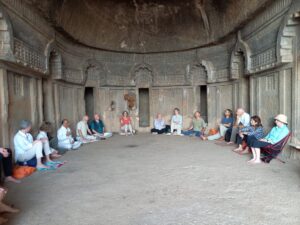
Fifteen days travelling with a group of 24 fellow “pilgrims”, together with Buddhist teachers Stephen & Martine Batchelor, Akincano Weber, Christoph Koeck, Shantum Seth and travel guide expert Ahmod exceeded all my expectations (and they were pretty high to start with!)
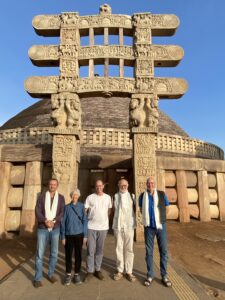
We all met up in Mumbai and from our first meeting it was clear that this was not a “tour”, but rather a pilgrimage wherein we were going to bring practice “back” to what these stone cut monasteries (“they are not caves” as Stephen B. corrected us on day one!) were constructed for in the first place – As places to gather, practice and learn the dharma. These monasteries, from the very small to the much larger ones we visited as we wound our way through the western Ghats of India, are indeed “not caves”. Rather, they were constructed by hand (you can still see the chisel marks in many places) out of solid rock mountain faces. The time and effort involved to carve these structures staggers the mind and calling them “caves” diminishes the incredible architectural accomplishments that they are.
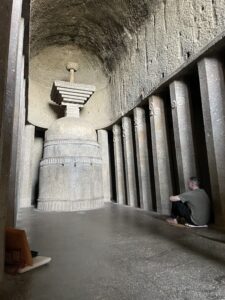
At one of the smaller less popular sites I had the opportunity to lie on my back, alone, in silence, in one of the monk’s mini alcoves off the main meditation hall. The felt sensations of the cool stone beneath my back was a perfect opportunity for an awareness of the body practice (body scan). As I lay in the alcove that was carved out by hand somewhere around the start of the common era I imagined how many others had done the same thing, in the same or similar ways, and how my inner experience of being distracted over and over again and the practice of returning to felt sensation as many times again, has essentially not changed in over a thousand years. The same questions I ask so many others have, and are still, asking; how to wake up to the way things are, how to see the interconnectedness of all things, and how to see the roots of suffering in greed, hatred and delusion?
The writer Pico Iyer (“The Half Known Life” 2023) sees travel as an opportunity for transformation “And if travel is like love, it is, in the end, mostly because it’s a heightened state of awareness, in which we are mindful, receptive, dimmed by familiarity and ready to be transformed. That is why the best trips, like the best love affairs, never really end.”
Travelling on long bus rides through rural India ones gets to see a lot of what we in North America might call “extreme 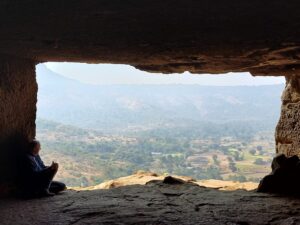
Pico Iyer again, “Many of us in the affluent world go to India or Tibet or Ethiopia or Cuba and feel that they are rich in the ways we are poor. There is a sense of community, sometimes a sense of faith, and a closeness to tradition that can sustain places more fundamentally than the checkbook”.
What else did we see? What we saw was groups of people including multigenerational families eating together at all times of 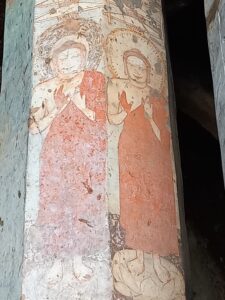
Another writer (and activist- environmentalist), Rebecca Solnit, has written a counter argument to the idea that we need to “give up things we love” if we want to avoid the worst of global warming. She questions whether our so called “world of abundance” is truly that. She questions what we have already given up or renounced, in our race to accumulate and consume as much as possible. “For the sake of fossil fuel, we’ve renounced so much. We’ve renounced clean air, we’ve renounced the future, we’ve renounced kids not having asthma in so many parts of the world. Because of fossil fuel emissions, about 8 million people a year die of respiratory problems related just to the particulate matter, not even to some of the other aspects. So what if we don’t live in an era of abundance, but doing what the climate requires of us, leaving the age of fossil fuels behind, could bring us to an era where the water is clean, the air is clean, the natural world is thriving, and we can feel more joy than anxiety when we look at it, where food is good for you, where people have more time for friendship, for joy, for time in the natural world, for creativity, or meditation, or cooking or painting or whatever gives us pleasure. And so how we tell the stories are so crucial, and not only the stories about the natural world, but deep down, the stories about human nature. What do we really want? What makes us thrive? What is the nature of our connections to each other? “
So, what is travel for? To be transformed? There is something about purposively immersing yourself in the unfamiliar that heightens attention, that leads to asking new questions, and may lead to a new appreciation for what we already have. Pico Iyer again: “I travel not to leave my home but to leave my habits behind so that I’m not sleepwalking”.
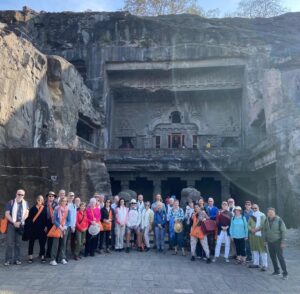
May you be well, fellow traveller on the path…
Stephen Liben
Montreal, Canada