
Courses
We run courses online and in person at beautiful venues across Europe.
We believe it’s not just about being mindful, it’s about learning how mindfulness makes sense in the rest of your life. Our courses help you to integrate mindfulness into your life, in all its myriad dimensions.
We offer online and in-person short & long courses and retreats. You can read here about the different formats.
Teachers Christina Feldman, John Peacock, Akincano Weber, Martine Batchelor, Bernat Font, Jaya Rudgard, Yuka Nakamura, Christoph Köck & Antonia Sumbundu are the core faculty of Bodhi College, with visiting teachers.
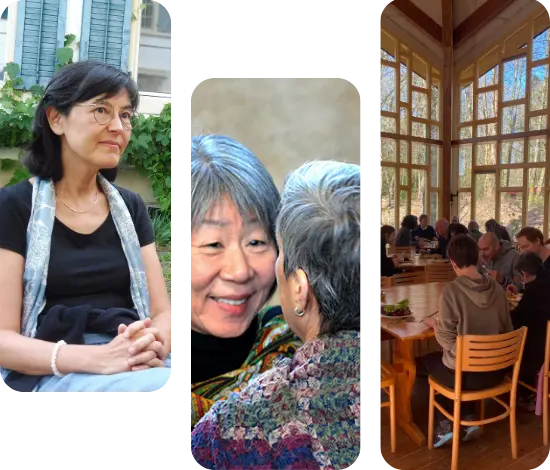
Choose your course

Dhammapada 2022 (F)
The Dhammapada is one of the most widely read and most loved teachings of the Buddha in existence. This beautiful collection of verses describes the Buddha’s vision of a path that embraces every area of our lives.
With Christina Feldman as the anchor she invites co-teachers to join her for the different sessions to reflect on various chapters of the text. She says about the Dhammapada:
“The Dhammapada is one of the most translated collections of the Buddha’s teaching. Presented in a wonderful poetic form it is an inspiring guide of how to navigate our way through life with understanding and easefulness. It is a teaching we can return to many times to inspire and support us. It is a timeless teaching as relevant today as it was in the time of the Buddha”.
What to do, how to live
Dhammapada 2024
The Dhammapada is one of the most widely read and most loved teachings of the Buddha in existence. This beautiful collection of verses describes the Buddha’s vision of a path that embraces every area of our lives.
With so many wonderful chapters to draw on, following the first Dhammapada course in 2022 (available as self-study here) Christina Feldman and Antonia Sumbundu decided to join again in 2024 to share their reflections on another series of chapters.
Christina on the Dhammapada:
“The Dhammapada is one of the most translated collections of the Buddha’s teaching. Presented in a wonderful poetic form it is an inspiring guide of how to navigate our way through life with understanding and easefulness. It is a teaching we can return to many times to inspire and support us. It is a timeless teaching as relevant today as it was in the time of the Buddha”.
Dhammapada 2022
The Dhammapada is one of the most widely read and most loved teachings of the Buddha in existence. This beautiful collection of verses describes the Buddha’s vision of a path that embraces every area of our lives.
With Christina Feldman as the anchor she invites co-teachers to join her for the different sessions to reflect on various chapters of the text. She says about the Dhammapada:
“The Dhammapada is one of the most translated collections of the Buddha’s teaching. Presented in a wonderful poetic form it is an inspiring guide of how to navigate our way through life with understanding and easefulness. It is a teaching we can return to many times to inspire and support us. It is a timeless teaching as relevant today as it was in the time of the Buddha”.
Samsara – Test course 4-2
‘Samsara’ is a key concept in Indian and Buddhist thought, which broadly means ‘going round in circles’. This rich and evocative idea can be understood cosmologically — as a beginningless cycle of birth, death and rebirth over aeons; psychologically — as repetitive patterns of neurotic thought and behaviour that prevent one from flourishing; and spiritually — as the opposite pole to the liberation, peace and enlightenment of nirvana.
Over four weeks, we will explore the meaning and implications of Samsara from these and other perspectives through talks, dialogues, breakout groups, open discussions and periods of silent reflection. How does this concept still speak to us today? How can we skilfully apply it to understand our own situation in life?
After Buddhism and Beyond
“After Buddhism and Beyond” was the title of a twelve-session live online course I taught over two semesters during the coronavirus pandemic from February 13 to June 26, 2021.
Organised by Bodhi College, it was attended by more than two hundred people from around the world. Each three-hour session was comprised of two thirty-minute seminars, both of which were followed by Zoom breakout groups and an open discussion. Students also met in study-groups between the sessions and participated in an online forum.
Samsara – Test course 4
‘Samsara’ is a key concept in Indian and Buddhist thought, which broadly means ‘going round in circles’. This rich and evocative idea can be understood cosmologically — as a beginningless cycle of birth, death and rebirth over aeons; psychologically — as repetitive patterns of neurotic thought and behaviour that prevent one from flourishing; and spiritually — as the opposite pole to the liberation, peace and enlightenment of nirvana.
Over four weeks, we will explore the meaning and implications of Samsara from these and other perspectives through talks, dialogues, breakout groups, open discussions and periods of silent reflection. How does this concept still speak to us today? How can we skilfully apply it to understand our own situation in life?
Mindfulness test course3
In the earliest teachings found in the Buddhist tradition, mindfulness is never presented as a stand-alone quality nor as an end in itself. Instead, mindfulness is presented as a quality and capacity in human consciousness, that is cultivated and developed simultaneously with a number of other qualities. A significant part of this extended family are kindness, compassion, joyfulness and equanimity - qualities that can equally be cultivated and developed. Together they form a complete path of awakening in which greed, hatred and confusion can come to an end. Thus, allowing us to thrive, flourish and deepen as human beings - responsive to the world within us and the world around us.
During this online course we will reflect on some of the nuances of mindfulness, the ways that it functions to bring distress to an end, and how it interfaces with the qualities of the heart that liberate. Some of the teaching material will draw on Christina’s recent book, written with Willem Kukyen, Mindfulness: Ancient Wisdom Meets Modern Psychology
Samsara – Or How to Stop Going Around in Circles
‘Samsara’ is a key concept in Indian and Buddhist thought, which broadly means ‘going round in circles’. This rich and evocative idea can be understood cosmologically — as a beginningless cycle of birth, death and rebirth over aeons; psychologically — as repetitive patterns of neurotic thought and behaviour that prevent one from flourishing; and spiritually — as the opposite pole to the liberation, peace and enlightenment of nirvana.
Over four weeks, we will explore the meaning and implications of Samsara from these and other perspectives through talks, dialogues, breakout groups, open discussions and periods of silent reflection. How does this concept still speak to us today? How can we skilfully apply it to understand our own situation in life?
Mindfulness and its Extended Family
In the earliest teachings found in the Buddhist tradition, mindfulness is never presented as a stand-alone quality nor as an end in itself. Instead, mindfulness is presented as a quality and capacity in human consciousness, that is cultivated and developed simultaneously with a number of other qualities. A significant part of this extended family are kindness, compassion, joyfulness and equanimity - qualities that can equally be cultivated and developed. Together they form a complete path of awakening in which greed, hatred and confusion can come to an end. Thus, allowing us to thrive, flourish and deepen as human beings - responsive to the world within us and the world around us.
During this online course we will reflect on some of the nuances of mindfulness, the ways that it functions to bring distress to an end, and how it interfaces with the qualities of the heart that liberate. Some of the teaching material will draw on Christina’s recent book, written with Willem Kukyen, Mindfulness: Ancient Wisdom Meets Modern Psychology